mardi 10 janvier 2012

North Laos - Muang Ngoi Neua

Les routes du Laos nous permettent de croiser de rencontrer de nombreux autres cyclotouristes, principalement européens. Nous échangeons, la plupart du temps, nos impressions et quelques recommandations pour la suite. C’est d’ailleurs grâce aux conseils d’un cycliste américain, vivant depuis une quinzaine d’année au Laos, que nous modifions notre trajet après Oudomxay. Nous préférons longer le cours d’eau « Nam Ou » sur une centaine de kilomètres jusqu’ à la ville de Khoa.

On our journey we have met quite a few cyclists on the way. Although so far we have only cycled once with some other people, we always exchange our experiences. When we got some insider tips of an American who had been living for over fifteen years in Laos and Thailand, we adapted our planned route and went further north from Oudomxay.


La vie semble paisible dans les petits villages accrochés aux rives du fleuve. Les enfants pêchent des algues pour ensuite les faire sécher au soleil avec du sésame et de l’ail. Certains coupent et tressent du bambou pour confectionner des paniers ou des cloisons pour les habitations. Comme loisirs, les gens s’amusent bien souvent à la pétanque, trace encore visible de l’ancienne Indochine française. Nous assisterons à plusieurs reprises à des petits combats de coqs, passe-temps exclusivement réservé aux hommes. En fin de journée, tout le monde se baigne dans les eaux de la rivière, les femmes vêtues d’un ‘
« Sarong », grande pièce de tissus couvrant tout le corps.

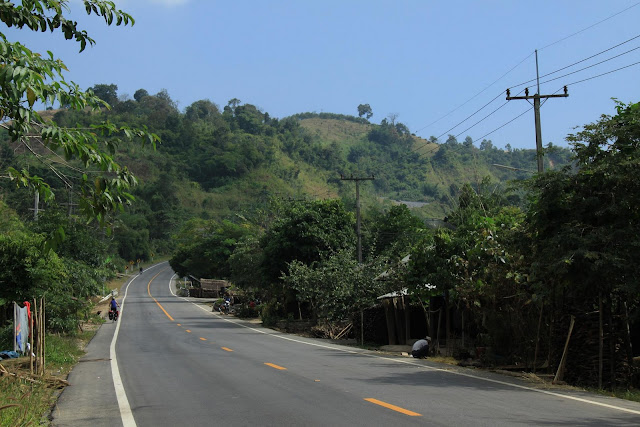
The brand new road was a scenic journey along the river Nam Ou. Over the 100km to Muang Khoa, we passed many small villages located at the river front. It was very interesting to watch the local life: children fishing sea weed in the river which then get dried in the sun with some garlic, sesame and tomatoes, and women cutting bamboo for the construction of houses and bridges. While the women were at work, many men passed their time with cock fights and “pétanque”, a game remaining from the French occupation.


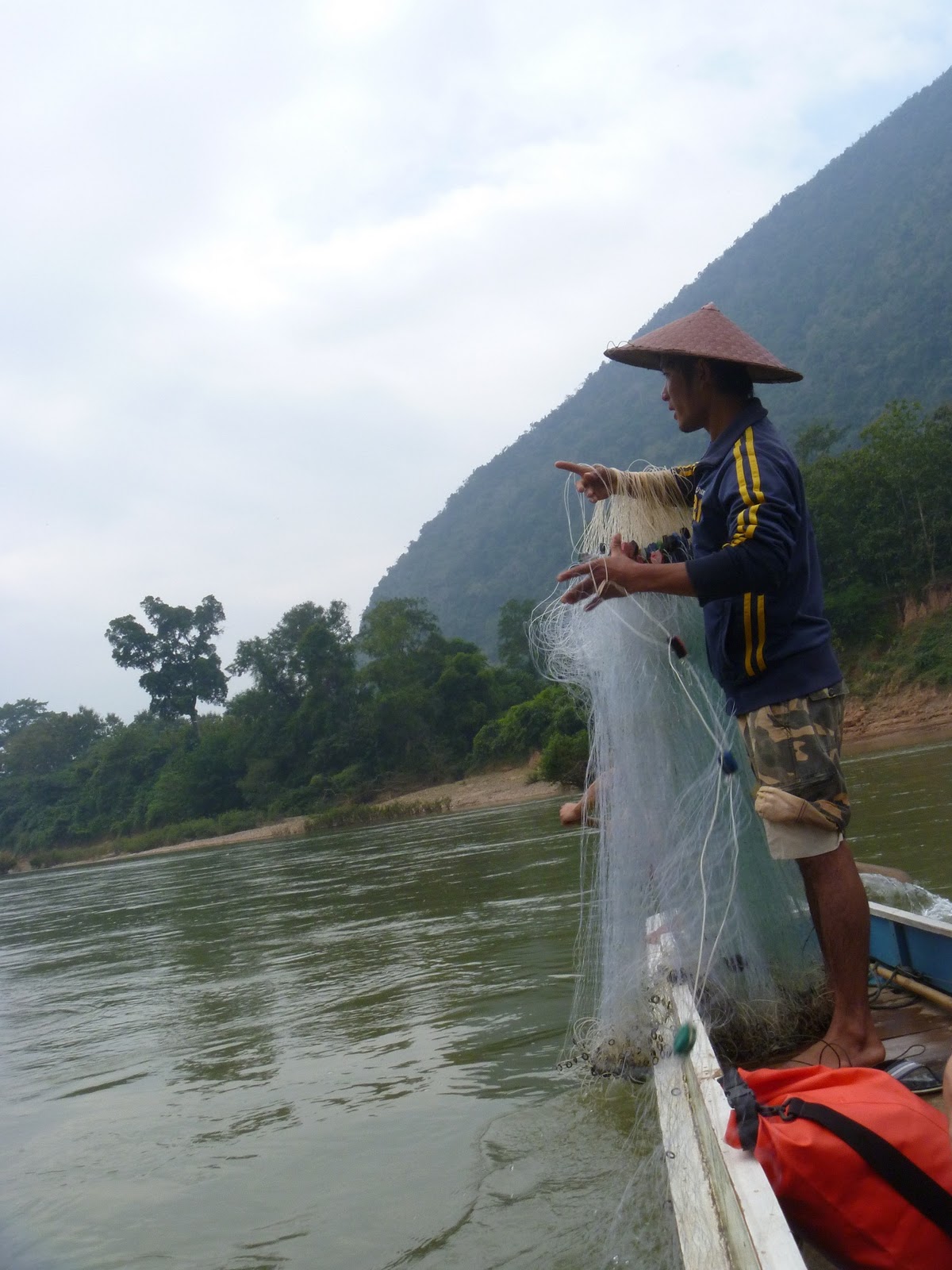
Arrivés à Khoa, nous prenons directement le bateau vers Muang Ngoi Neua, petit village uniquement accessible par les eaux, ou les voitures et motos sont inexistantes. Cette tranquillité en fait l’endroit idéal pour se relaxer quelques jours et laisser au repos nos deux-roues. Pendant une matinée, nous accompagnons quelques pêcheurs du coin, avec d’autres belges et un canadien, pour apprendre plusieurs techniques de pêches. Le résultat sera peu convaincant… Nous grillerons les deux malheureux petits poissons attrapés avec un de leur grand frère, rapporté pour l’occasion. Comme lot de compensation, un des pêcheurs nous proposera un cochon à la broche pour le soir. Difficile de refuser !

In Muang Khoa we loaded our bicycles on the roof of a small boat in order to get to Muang Ngoi Neua, a small village only accessible by cars and without any motorized vehicles. Although we had planned of staying only for a night, we just looked at each other when we stopped of the boat and knew we would stay longer, this place was just so relaxing.

On our first day we were happy just to spend some time in our hammocks on our terrace and enjoyed the beautiful view over the river with a good book. On the second day we went on a fishing trip with some local fishermen and a nice group of Belgians and a French speaking Canadian with whom we had already spent some time drinking cocktails in the evening. Although we learned the different techniques the outcome wasn’t that impressive. According to the fishermen it was to cold and the fish were “sleeping”. So after a rather sparse lunch (thankfully, the fishermen had brought one “emergency fish” with them) we got the proposal to grill a pig in the evening. It was hard to decline the offer, so  we all met up again in the evening for another sociable gathering.






samedi 10 décembre 2011

North Laos - Viengphukha


Arrivés par bateau à Houaxay, nous décidons de rejoindre la ville de Louang Nahmta, dans les montagnes du nord du pays. Apres seulement quelques kilomètres, nous nous rendons vite compte de la différence avec la Thaïlande. La transition est frappante. Bien que les paysages soient similaires, les maisons sont beaucoup plus modestes, bien souvent sans électricité. Les routes sont, pour la plupart, en mauvais état ou en construction et étrangement désertes. Seuls de gros camions thaïlandais se croisent dans la poussière pour faire la navette jusqu’en Chine.


So we have made it to Laos, and I can only say what a start!
The border crossing from Thailand was actually pretty easy. We had our own little boat and the guy even helped us with our bikes.  We already had our Visas in advance so all went pretty smoothly.


The cycling started pretty easy, back on the “normal” side of the road and much lighter traffic than in Thailand. The only thing to watch out is the trucks.


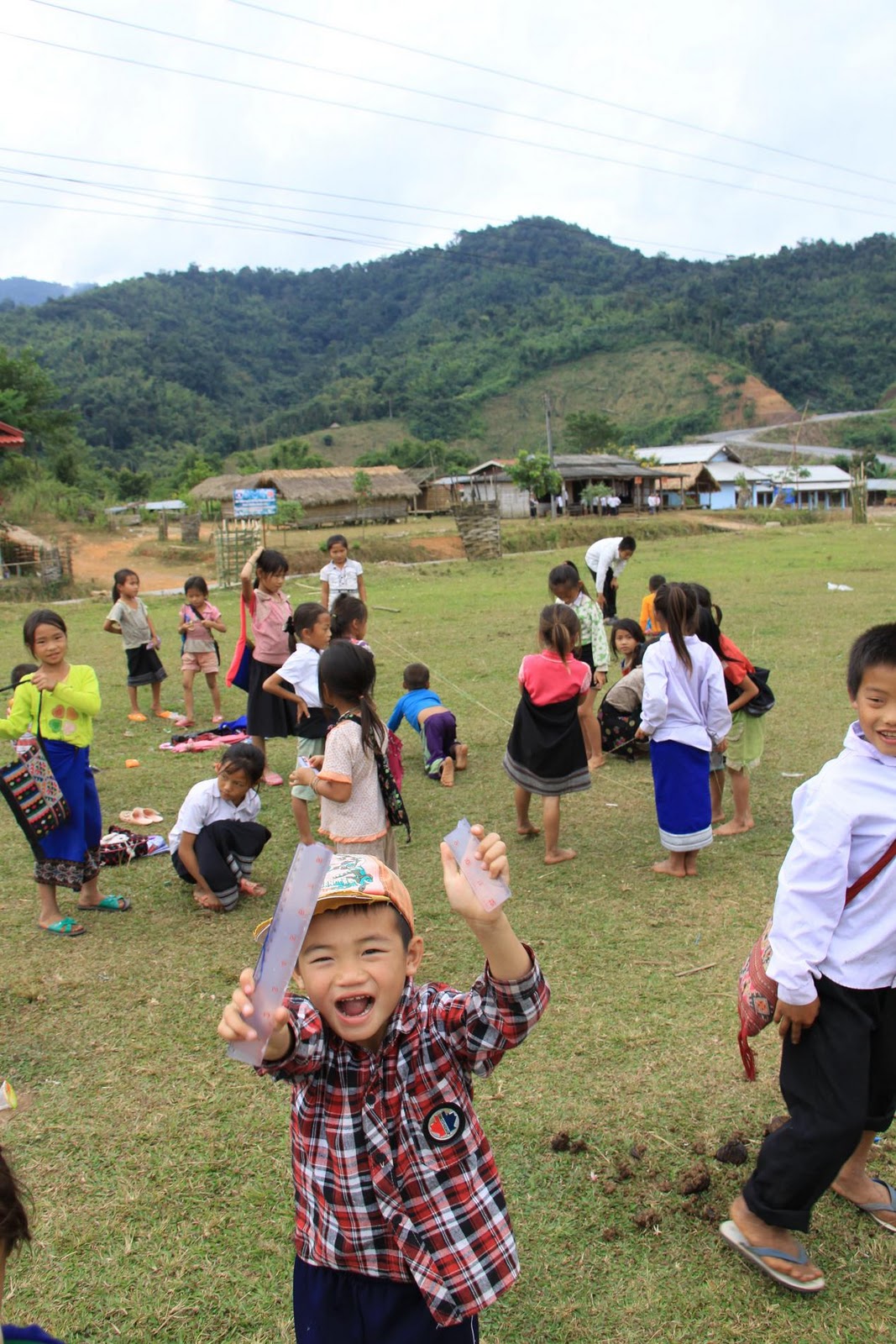
Mais le plus étonnant reste la réaction des enfants a notre passage. A chaque village, ils s’empressent de nous saluer de plusieurs « SABAI DEE » (Bonjour) et certains s’amusent même parfois à nous défier à vélo ou en courant quelques mètres à nos côtés.

We quickly realized that everything is much poorer over here and that there seem to be very few tourists passing the small villages.  In every single village the children are running after us shouting ‘Sabai Dee”, wave and run after us.  At our first lunch we noticed that we really were the attraction when a circle of adults and children formed around us watching us eat. This is quite something to get used to!


Le premier jour, la nuit tombant, nous n’avons pas d’autres choix que de nous arrêter au village de Naluang. Aucune trace de guesthouse parmi les cabanes en bois... Juste un petit commerce ou les gens s’amassent lorsque nous nous arrêtons pour acheter des pâtes et un peu d’essence pour le réchaud. Nous rencontrons par chance un jeune homme avec quelques bases d Anglais. Il nous propose de loger dans l’école du village, ce que nous acceptons avec plaisir. Nous souperons sous les yeux médusés de quelques villageois avant de passer notre première nuit entre les bancs de l’école...

We soon were in the mountains which are much less populated than the north of Thailand, making it difficult to find  eating and sleeping opportunities. So when it slowly started to get dark we decided to call it a day in a small village we came pass as we had no idea how far the next one would be.  There was no guesthouse and now restaurant around but we were lucky and go the offer to spend the night on the floor of the local primary school.  In the local shop we managed to get some noodles and some petrol so we even managed to cook us a warm meal in company of the local children.  We piled on all our clothes we have with us as the nights here get pretty chilly!


Quelques jours plus tard, nous stoppons à Viengphukha pour y faire un trek de 3 jours avec une agence d’éco-tourisme, reversant 40 % de l’argent aux villages visites. Accompagnés d’un guide, de son assistant et d’une touriste tchèque, nous démarrons au petit matin par un longue montée dans la foret ou nous croisons un petit groupe de villageois préparant la soupe pour les porteurs de riz. Nous en croiserons plusieurs par la suite, hommes et femmes, portant chacun un sac d’une quarantaine de kilos.

After some not so easy riding (we managed to get soaked one day and crossed our first 1000m mountain) we finally arrived in Viengphouka where we had planned to do some trekking. We signed up for a three day trek through the Long Nam Ha National Park and to some local villages.

On the trek there were just the two of us and a really nice czech girl from England, Martina. We were accompanied by a local guide who spoke good English and a guide assistant. The first day walking was fairly long with 7 hours heading up and down in the jungle, the following days were a bit easier. The bamboo forest was in particular impressive and some of the views were stunning.


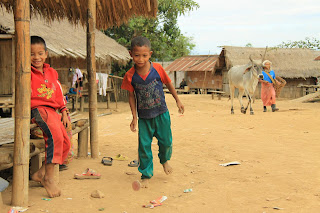
Apres un copieux repas étalé sur quelques feuilles de bananier et quelques verres de whisky de riz, nous atteignions notre premier camp de base en fin de journée : un village Hmong regroupant 3 familles, dont une qui nous hébergera. Pas d’école, encore moins de pharmacies pour ces communautés coupées du monde. Les enfants jouent à une version de toupies en bois, seule véritable occupation parmi les veaux, poules et autres porcs entourant les maisons. Nous dormirons sur une paillasse de bambou, juste a côté de la famille s’étant regroupée à proximité du feu.

During the Trek we shared the house with local families. Particularly the first night was pretty surreal. The village consisted of three houses, completely remote and cut off from the outside world. There must have been at least nine children sleeping in the same space as us and sometimes we were not sure if the noises came from them, the pigs, the chicken or any of the other animals trying to get into the interior.


Le lendemain, nous resterons dans un village beaucoup plus grand, regroupant deux communautés Hmong et Lao, d’environ 350 personnes. La soirée sera l’occasion pour nous de tester quelques pas de danses dans la salle du village, sans grand succès…

The second village was already much more developed and closer to the “city”. Our meals were still cooked on an open fire but there was a school and people had scooters and phones.  In the evening we gathered with the village people around an open fire to warm ourselves and Martina and I joined the young girls practicing their dancing. However, they did not appreciate it when we tried to teach them the Moon walk or yellow submarine moves!


We have now hit the road again and are currently in Luang Namtha, a touristy city know for its trekking opportunities.  Having done a trek already, we will carry on our journey further east to Oudoumxay  and Khoa in order to get the the River Ou where we have planned to take a boat southwards.


lundi 28 novembre 2011

North Thailand - Chiang Kong


En quittant le parc National Si Lanna, nous rejoignons la route principale menant aux villes de Chiang Dao et de Fang. Le trafic y est tout d’abord assez dense et le paysage monotone. La route se rétrécit ensuite et nous mène progressivement au cœur de la forêt et au sommet de plusieurs cols, dont certains atteints dans une certaine douleur, la préparation manquant un peu...


I am amazed how much I am liking Thailand! I have to say it was the only country on our route that I wasn't that bothered about visiting but it has been a very positive surprise! People here are so friendly, everybody smiles at us and waves and the kids here are just great!
.


Nous ferons une halte de deux jours à Thaton. Tôt au matin, nous accompagnons 3 enfants se rendant à l’école pour visiter un petit village dans les montagnes, à la frontière avec la Birmanie. Un rapide petit tour des lieux nous permet de découvrir la vie du village. Quelques groupes d’adultes s adonnent a des jeux de lancé de pièces, pendant que le coiffeur rase la barbe d’un villageois dans son jardin... Les enfants, intimidés dans un premier temps par l’appareil photo, se laissent rapidement prendre au jeu, éclatant de rire en voyant leur portrait a l’écran.


We have spent two nights in Thanton, a small town with a few tourists who all just stop over to take a boat to Chiang Rai, a very touristy city in the north. We liked the place at once and decided to spend some time here. We found a lovely little hotel, a great place for food (obviously no English spoken) where we ate three times and met plenty of people. We spent a day trekking in the moutains, visiting a local small village and some temples. On the way to the village we got some company, a small group of children decided to join us, chattting happily in Thai until we reached our destiantion. Once arrived in the village, we had a great laugh with the children there, taking photographs of them and teaching them how to use a camera.


Notre itinéraire se rapproche alors petit à petit du Laos. A Chiang Saen, toute la vie de la ville s’étend le long du Mékong, frontière physique avec le Laos. Au marché, chaque commerçant est fier de montrer ses plus gros poissons, pendant que les anguilles et autres serpents gigotent encore dans les bassines. Le soir tombé, c’est sur les berges du fleuve que s’installent tous les marchands ambulants, proposant de nombreux plats à base de poissons. Plusieurs d’entre eux terminent la soirée par un lâché de lanterne volante, symbole de chance.

Nous traverserons la frontière en bateau quelques jours plus tard à Chiang Khong, pour rejoindre Houaxay, point de départ du périple dans les montagnes du nord du Laos.

Since Thanton we had some hard but also rewarding biking days in the mountains. Some of the climbs were very steep and the temperatures got very hot. When we got to 39 degrees (it felt like 50!) and we had a climb of 18 % in front of us we actually gave up and pushed the bikes for a while. Thank god that not all of the days are like that! But once we made it to the top we got some amazing views over the landscape and enjoyed the well deserved downhill ride!

A few days ago we arrived in Chiang Saen and finally saw the Mekong! We could already feel the fresh breeze of air of the river some km away and couldn't wait to finally get there. In the evning we got to enjoy a nice cold beer sitting at one of the stalls along the river, watching some locals lighting paper lamps which flew into nightsky.

We are currently in Chiang Khong and tonight is going to be our last night in Thailand. Tomorrow we will cross the Mekong for some new adventures in Laos. We are currently trying to figure out the route, as we think we might want to spend some more time in the mountains (this trip was alwazs gonna be a bit of a challenge, so why not push it a bit further??) in the north of Laos before entering the south with its vast planes of rice fields. We will keep you updated...